• Twitter
  • LinkedIn
  • Facebook
Call us at 888.619.2226
Glass Paint
  • Home
  • About
  • BUY ONLINE
  • INFO
    • PRODUCTS / DATA / VIDEOS
    • HGTV
    • FAQs
    • Make Your Own Colors
    • LIMITED WARRANTY
  • Gallery
  • Contact Us
  • Blog
  • Search
  • Menu Menu
  • 0Shopping Cart

Glass fiber development aids aviation

October 25, 2016/in Blog, Glass Paint/by eileen
Glass fiber development aids aviation

Glass fiber development aids aviation

Airbus and Fokker have teamed up to further develop an aviation material known as fiber metal laminate (FML). FML was developed for use on airplane fuselages to lighten the weight of the aircraft. FML is made from alternating layers of aluminum and glass fibers. The material is used in strategic areas of the aircraft, and can reduce the finished weight of a vehicle by about 15%.

The companies intend to develop high-volume production methods and tweak the material formula to incorporate newer glass fibers into the mix. According to the companies, “smart” production – which could be conducted primarily by robots – will lower the cost of the material and make it more attractive to aircraft manufacturers. FML has been used successfully on the upper fuselage and the tail structure of the Airbus A380 since it was developed.

FML was originally created by Fokker, a Dutch aviation company along with researchers from the Technical University of Delft and the National Dutch Aerospace Laboratory about 20 years ago. It was successfully integrated into A380 production in 2005. It is attractive because it offers a high degree of strength and can be produced more sustainably and at a lower cost than more traditional airframe materials. It also offers a viable lightweight alternative to traditional components, and has a fire safety rating that

The first generation material is known as GLARE (glass laminate aluminum reinforced epoxy). During manufacturing, the glass fiber layers can be oriented to produce a finished material with a highly predictable stress response.

GLARE can be repaired using traditional metalworking techniques, another plus for an industry that’s highly dependent upon field-based repairs. It has a better tolerance for damage than aluminum, as well as better corrosion resistance. It also provides a good demonstration of the versatility of glass.

Glassprimer™ glass paint is a specialized glass coating that bonds permanently to glass surfaces. GlassPrimer also makes a glass surface molecular activator that is designed to work with UV-inkjet glass printing processes. For more information about Glassprimer™ glass paint, please visit the rest of our site. If you’d like to purchase Glassprimer™ glass paint, please visit our online store.

Photo Credit: Greg Hounslow , via Flickr.com
Glass was an ancient status symbol

October 24, 2016/in Blog, Glass Paint/by eileen

Glass was an ancient status symbol

Glass was an ancient status symbol

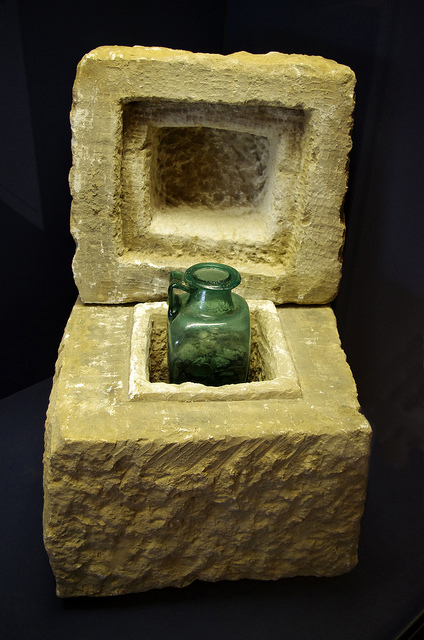
An archaeology researcher from the University of Leicester in the UK believes that early civilizations used glass as a status symbol rather than as a practical material. Dr. Chloe Duckworth says that ancient civilizations invested in technologies like glassmaking more as a display of power.

She bases the hypothesis on the examples of early glasses, most of which were opaque or heavily colored. They often resembled semi-precious and precious materials like lapis lazuli and carnelian, which were used extensively by the wealthiest and most powerful people in society. Early examples of glass were almost exclusively used in decorative applications, and as containers for perfumes and oils that would not have been available to ordinary citizens.

Duckworth looked at the evolution of glass blowing and determined that it was a response to societal needs rather than a driver. She believes that glass may have originally been envisioned as a way to fill a social need, and did not morph into a useful material that was available to the masses until much later in the material’s history. She points to modern uses for glass, including fiber optic cables and precision lenses, and says that early developers of the material did not see the practical uses of glass, even for more mundane applications like windows and practical storage containers.

Today, we tend to look beyond the decorative capacity of glass and focus on its most practical applications. In reality, glass can be both practical and decorative. One characteristic of glass is its impervious surface. On one hand, it allows light to flow freely through it. On the other hand, opacity is sometimes preferred.

Glassprimer™ glass paint is a specialized glass coating that bonds permanently to glass surfaces. GlassPrimer also makes a glass surface molecular activator that is designed to work with UV-inkjet glass printing processes. For more information about Glassprimer™ glass paint, please visit the rest of our site. If you’d like to purchase Glassprimer™ glass paint, please visit our online store

Photo Credit: Daniel Jolivet, via Flickr.com

Iconic Glass Structures – Crystal Cathedral

October 23, 2016/in Blog, Glass Paint/by eileen
Iconic Glass Structures – Crystal Cathedral

Iconic Glass Structures – Crystal Cathedral

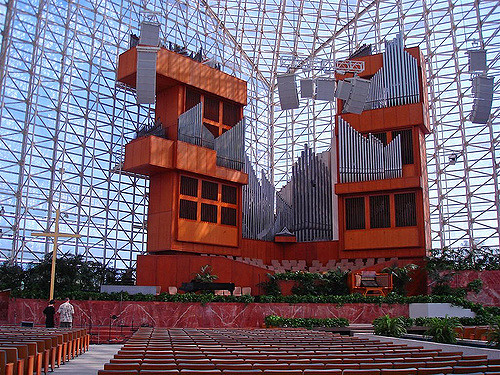
No discussion of iconic glass structures would be complete without looking at the former Crystal Cathedral, now known as Christ Cathedral in Garden Grove, CA. The cathedral was originally built between 1977 and 1980 for the Garden Grove Community Church. The building has an area of about 75,000 square feet and seats about 2,750 people. The building was originally designed by architect Philip Johnson and was built at a cost of about $18 million. The church was dedicated in 1980 by Robert Schuller, a minister in the Reformed Church of America.

In 2010, the congregation ran into severe financial trouble, and ultimately declared bankruptcy, claiming more than $43 million in liabilities. The church was purchased by the Roman Catholic Diocese of Orange for about $57 million, and is undergoing major interior renovations. The exterior of the building will remain largely unchanged. The Diocese of Orange intends to move its operations onto the campus wjem reconstruction is complete.

The outer structure of the building is made from steel and more than 10,000 rectangular glass panels that are not mechanically fastened to the structure. Instead, the panels are glued in place using a silicone adhesive. The building was designed to withstand an 8.0-magnitude earthquake. The 1857 Fort Tejon earthquake remains the strongest recorded earthquake in California. That quake had a magnitude of 7.9. The largest-ever recorded earthquake is the 1960 Valdivia earthquake, which occurred in Chile. That quake had a recorded magnitude of 9.5.

One issue the renovations address is solar heat gain, which can be intense in the building. The new interior design will feature quatrefoil shades and tall walls that will line the sanctuary area. The interior has been completely redesigned in part to shift the focus of the worship from the pulpit to the altar. The walls and floors will be made of walnut and limestone, and the altar will include travertine and Italian marble.

As a side note, the building houses the fifth-largest pipe organ in the world. The organ was actually constructed from two different organs and was prominently featured in the Hour of Power television show that was produced by the Garden Grove Community Church. The organ will continue to occupy its traditional space, but the Diocese took the opportunity to refurbish the organ during construction. The organ was dismantled and sent to Italy to be repaired. It has since been shipped back to California and will be re-installed following the completion of the interior construction.

The construction of the worship space is expected to be finished in 2018, and final construction on the campus is expected to be complete by 2019.

Glassprimer™ glass paint is a specialized glass coating that bonds permanently to glass surfaces. GlassPrimer also makes a glass surface molecular activator that is designed to work with UV-inkjet glass printing processes. For more information about Glassprimer™ glass paint, please visit the rest of our site. If you’d like to purchase Glassprimer™ glass paint, please visit our online store.

Photo Credit: radiobread , via Flickr.com

Graphene helps eliminate glass corrosion

October 22, 2016/in Blog, Glass Paint/by eileen

Graphene helps eliminate glass corrosion

Graphene helps eliminate glass corrosion

Researchers at the Center for Multidimensional Carbon Materials have discovered that graphene can help glass resist corrosion. Glass is highly resistant to corrosion by itself, but certain substances can weaken and corrode glass. Under certain conditions, like high humidity and high pH, glass can corrode. When that happens, the glass weakens and loses its transparency.

A complex chemical reaction that occurs at the nanosurface is responsible for the corrosion, so glass coatings that can resist the beginning stages of this reaction are much sought-after. Graphene is chemically inert, and it can be applied in a thin film. In addition, it is transparent, so it’s an ideal coating for glass.

Graphene coatings can protect against a wide variety of conditions including corrosion, oxidation, friction, bacterial infection and electromagnetic radiation, so the coatings could protect a variety of other surfaces, in addition to glass.

The researchers developed a two-atom-thick coating of graphene on copper, and transferred it to glass. After submerging the glass in 140° F water for 120 days, scientists noted that the uncoated glass showed significant material changes to its surface, while the coated glass was in virtually the same condition it was in prior to being submerged. Although the test coating was two atoms thick, the researchers say they can achieve the same results with a one-atom thick graphene coating.

Nanoscale changes to the surface of the glass have a number of uses. It’s the principle on which Glassprimer™ glass paint was engineered. Glassprimer™ glass paint bonds directly and permanently with the surface of glass. In addition, it offers exceptional UV resistance, which means it won’t fade, even in direct sunlight.
Glassprimer™ glass paint can be tinted to match the paint palettes of all major paint packages, so you can incorporate it easily into any decorating plan.

If you’d like more information about Glassprimer™ glass paint, please visit the rest of our site. If you’d like to purchase Glassprimer™ glass paint, please visit our online store .

Photo Credit: Geek2Nurse, via Flickr.com

European Group Calls Glass a Permanent Material

October 21, 2016/in Blog, Glass Paint/by eileen
European Group Calls Glass a Permanent Material

European Group Calls Glass a Permanent Material

The European Commission’s ITRE Committee has agreed with the results of a study conducted by the European Container Glass Federation, which determined that glass is a “permanent material.” The designation is important because it means that container glass is a primary raw material for new glass. The goal of the Commission is to identify materials that can be recycled effectively and repeatedly, in order to reduce the amount of new or raw materials that are extracted from the land.

Glass is particularly interesting as a recycled material because cullet (pulverized glass) reduces the amount of energy needed to reform the glass into new containers. This also meets another of the Commission’s goals – reducing the amount of energy used in material manufacturing in Europe.

The designation is currently dependent upon the development of effective glass recycling programs in all European Union countries. According to the study, about three-quarters of all container glass in Europe is recycled, but the actual percentage varies from country to country. The flip side of that is the 25% of container glass that makes its way into landfills in Europe. The Commission would like to find ways to more effectively recycle, and reduce the amount of container glass that gets thrown away.

The study is part of the recently adopted “Circular Economy Package” by European Union countries. The aim of the Circular Economy Package is to promote more recycling, to set recycling and landfill targets, and to incentivize the use of recycled materials among EU member nations.

While the study itself applies to container glass, the goal of recycling and reuse of glass increases the long-term likelihood that glass will play a more important role in material use in Europe. Glass is both a decorating and working surface, and will be used more extensively in EU countries as a way to meet “Circular Economy” targets.

Glassprimer™ glass paint is specially formulated to bond permanently to glass surfaces. The paint works on all types of glass, and will not chip, fade or peel once the paint has cured. Curing takes place within 72 hours of application, and can be used on both interior and exterior applications. In addition, Glassprimer™ glass paint offers exceptional UV resistance, even when exposed to direct sunlight.

If you’d like more information about Glassprimer™ glass paint, please visit the rest of our site. If you’d like to purchase Glassprimer™ glass paint, please visit our online store .
Photo Credit: Michael Rosenstein , via Flickr.com

New glass coating could improve water runoff

October 20, 2016/in Blog, Glass Paint/by eileen

New glass coating could improve water runoff

New glass coating could improve water runoff

A group of Chinese researchers has developed a new super-hydrophobic coating that can be applied to hard surfaces, including wood, glass, metal and fiber. The new coating is durable and can resist a variety of actions, including handling, scratching and brushing. Textiles coated with the material retained their original hydrophobic properties even after being abraded with sandpaper.

The coating enables “self-cleaning” on a wide variety of surfaces. In addition, the coating can survive intact even in high heat and high humidity for sustained periods of time. The nanoscale coating was tested on a number of common surfaces, including glass, copper and wood. The coating can also be applied easily in a large-scale production environment. The researchers have not indicated when or how this new coating may be commercialized, or whether additional development is required.

Coatings are taking on a new importance in materials engineering. Coatings can introduce new properties to materials cost-effectively. Glassprimer™ glass paint is a good example of this.

Glassprimer™ glass paint is a specially engineered glass coating that’s designed to adhere permanently to the glass surface. As a paint, Glassprimer™ glass paint comes in virtually every color available through major paint manufacturers.

Glassprimer™ glass paint can be applied to glass and a range of other non-porous surfaces and provide complete coverage for about $1 per square foot. Once cured, Glassprimer™ glass paint makes a permanent bond with the glass that will not chip, fade or peel, even in harsh conditions.

Glassprimer™ glass paint is ideal for both interior and exterior work, and offers exceptional UV-resistance. That means it won’t fade, even in direct sunlight. It can also be used to control solar heat gain, and treat windows that don’t offer an aesthetically pleasing view, or where additional privacy is desired.

Glassprimer™ glass paint is a specialized glass coating that bonds permanently to glass surfaces. GlassPrimer also makes a glass surface molecular activator that is designed to work with UV-inkjet glass printing processes. For more information about Glassprimer™ glass paint, please visit the rest of our site. If you’d like to purchase Glassprimer™ glass paint, please visit our online store
Photo Credit: alfarman , via Flickr.com

Venezuela Nationalizes Guardian Glass Plant

October 19, 2016/in Blog, Glass Paint/by eileen
Venezuela Nationalizes Guardian Glass Plant

Venezuela Nationalizes Guardian Glass Plant

Guardian Industries, one of the largest manufacturers of float glass in the world, announced that the Venezuelan government nationalized its float glass plant in the State of Monagas in July. Following the shutdown, the government invoked a law that allows it to seize abandoned manufacturing facilities. Guardian says that the facility was not abandoned, and that the company had shuttered the facility to replace aging production equipment. Typically, the equipment in glass plants runs around the clock for about 15 years before being shut down for maintenance or replacement.

The Guardian glass plant was not the government’s only seizure target. Kimberly-Clark also lost control of a diaper manufacturing plant in the country. That plant, near Caracas, manufactured nearly half of the diapers sold in Venezuela.

In early August, the Venezuelan government announced that it had “restarted” the Guardian plant, but it is not clear what, if anything, is being manufactured there. The government said it intends to manufacture about 350 tons of flat glass per day. Following the seizure, Guardian issued a warning about the condition of the plant, saying that the existing equipment in the plant was “end-of-life” and that continued use could be dangerous.

Manufacturing is exceptionally difficult in Venezuela at the moment due to the country’s runaway inflation. Kimberly-Clark said it ceased manufacturing at its Caracas-area plant because it could no longer purchase raw materials. Guardian said it shut down its Monagas glass plant as part of a planned upgrade to the equipment there.

Venezuela has a history of seizing the assets of foreign companies since the 1990’s. Extreme economic pressures are contributing to the increasing desperation inside the country. Venezuela is heavily dependent on the sale of oil to fund its national treasury. Since the price of oil has dropped to near-record lows, the country’s economy has spiraled into a deep depression. Widespread unemployment and high inflation have both stripped the shelves of retailers and made importing products next to impossible.

Guardian could petition the World Bank for a judgment in its favor, but even being compensated for the seizure could be meaningless. Owens-Illinois was awarded compensation from the World Bank in 2011 for the loss of two glass manufacturing plants in Venezuela, but has yet to receive any payments. Guardian could also write off the loss, which would take both the asset and the associated expenses (including debt) off of the company’s books.

Glassprimer™ glass paint is a specialized glass coating that bonds permanently to glass surfaces. GlassPrimer also makes a glass surface molecular activator that is designed to work with UV-inkjet glass printing processes. For more information about Glassprimer™ glass paint, please visit the rest of our site. If you’d like to purchase Glassprimer™ glass paint, please visit our online store.

Photo Credit: Julio Cesar Mesa, via Flickr.com

Solar energy hits the road

October 18, 2016/in Blog, Glass Paint/by eileen
Solar energy hits the road

Solar energy hits the road

Route 66 evokes images of open road, but this stretch of America’s past may be making some new history in Conway, MO. A local rest stop there is being retrofitted with about 50 glass solar panels, but these collectors won’t be mounted on a roof. Instead, they’ll be embedded in the sidewalks around the rest stop. The goal is to provide all of the rest stop’s energy.

The experiment is part of a plan by an Idaho company called Solar Roadways. If the sidewalk test passes muster, the panels will be shifted to the parking lot, then to the entrance and exit ramps leading to the highway. The Solar Roadways panels heat themselves, so there’s no need to provide winter maintenance. They also have lights that can be configured to display lane markers and inform drivers about road conditions ahead.

The road ahead for solar highways isn’t going to be easy. The panels will have to prove their mettle when it comes to traction, weight, weather and temperature – all of the elements that go into making potholes on current road surfaces. Even if the proof-of-concept project survives, it would also have to overcome the fact that solar panels in the roadways are expensive – much moreso than standard cement, asphalt and other traditional paving materials.

Other companies are also experimenting with solar surfaces for roadways, roofs and other structures in various locations around the world. The goal is to develop materials that are both durable and productive. The cost of the solar road panels could be offset by tolls, or by transferring excess energy generated by the panels to the grid.

According to the company website, the solar glass panels are tempered, and are strong enough to support the weight of a semi-truck. The glass also has a roughened surface that gives it as much traction as asphalt. Each full-sized glass panel can generate about 48 watts of power, using about 4.5 square feet of space. The panels are hexagonally shaped.

In addition to the installation in Conway, MO, the company is also working on a public installation in Sandpoint, ID, Solar Roadways’ hometown.

Glassprimer™ glass paint is a specialized glass coating that bonds permanently to glass surfaces. GlassPrimer also makes a glass surface molecular activator that is designed to work with UV-inkjet glass printing processes. For more information about Glassprimer™ glass paint, please visit the rest of our site. If you’d like to purchase Glassprimer™ glass paint, please visit our online store

Photo Credit: Solar Roadways

Research opens up metallic glass

October 17, 2016/in Blog, Glass Paint/by eileen

A team of researchers from Duke University, Harvard University and Yale University are unlocking the secrets of metallic glass. Sometimes, molten metal cools too fast. When this happens, the atoms don’t have time to arrange themselves in the standard crystalline structure that defines most solid materials. Instead, the atoms in these metals cool and harden in random patterns, in exactly the same way that ordinary glass does. The resulting product is known as a metallic glass.

Scientists know how to create metallic glasses, but they don’t know – before they actually generate the glass – what properties the resulting glass will have. In some cases, metallic glasses may be conductive, super strong, super hard or they may have other properties that are equally desirable or specialized. The trial-and-error nature of the process makes discoveries among metallic glasses slow, and a bit of a mixed bag.

The researchers have discovered a way to predict the properties of a metallic glass product without having to manufacture or tweak anything. The process promises to save time and money, and could lead to the development of novel materials with highly desirable properties.

The researchers created a database and simulation software that examines all possible outcomes of a combination of elements, given the materials provided and their tendencies to form certain structures in nature. The simulation looks at a variety of atomic characteristics, and based on the information, is able to determine the likelihood that a particular selection of materials will bond. It can also determine the likelihood that other materials with similar atomic characteristics will bond.

The simulation allows the researchers to identify candidate materials that are more likely to bond together in a novel way. By eliminating material combinations that are likely to fail, scientists can spend more time in the lab working with materials that have a higher probability of success.

To determine the value of their simulator, the researchers tested their simulation on materials that are already known to produce metallic glass. The simulator correctly predicted successful combinations about three-quarters of the time.

At present, about two dozen known metallic glasses exist. If the simulator is correct, the researchers may be able to generate about 250 new combinations of metallic glasses with different, useful properties. So far, the simulator works with just two alloys, but the researchers have plans to reconfigure it to consider the possible outcomes of working with three different alloys. In the mean time, the researchers can also work on creating metallic glasses from the possibilities the similar has identified.

Glassprimer™ glass paint is a specialized glass coating that bonds permanently to glass surfaces. GlassPrimer also makes a glass surface molecular activator that is designed to work with UV-inkjet glass printing processes. For more information about Glassprimer™ glass paint, please visit the rest of our site. If you’d like to purchase Glassprimer™ glass paint, please visit our online store.

Iconic Glass Structures – Petronas Towers

October 16, 2016/in Blog, Glass Paint/by eileen
Iconic Glass Structures – Petronas Towers

Iconic Glass Structures – Petronas Towers

No series on iconic glass structures would be complete without discussing Petronas Towers in Kuala Lumpur, Malaysia. The twin towers were classified as the tallest building in the world between 1998 and 2004, and remain the world’s tallest twin towers, according to the Council on Tall Buildings and Urban Habitats (CTBUH).

The Petronas Towers were designed by Argentine architect Cesar Pelli. The original design for the project was conceived in 1992, and underwent significant simulation testing to ensure that it could withstand wind and other forces that would act upon the structure once it was built.

Construction of the glass and steel towers began in 1993 and continued for seven years, although tenants occupied parts of the project before construction was entirely complete. The site for the building originally hosted a racetrack. Before construction began, tests showed that about half of the site was covered in decayed limestone. The entire building site was shifted about 200 feet to ensure that the project could be built on a suitably strong foundation.

In addition to being one of the world’s tallest structures, the Petronas Towers also hold the distinction of having the world’s deepest foundations. In some areas, the building’s foundations, which rest on more than 100 concrete pilings, extend nearly 375 feet into the Earth.

The 88-floor towers are clad in glass and steel. The towers were constructed simultaneously by two different construction crews in order to meet the Malaysian government’s requirement that construction be completed within 6 years.

The towers feature nearly 600,000 square feet of laminated glass, and a two-story bridge that connects the two towers at the 41st and 42nd floors. Despite the high profile of the Petronas Towers, a considerable amount of unused space is available for lease in the second tower. The first tower is completely filled. Retail space is available on the lower levels of the towers. The upper floors of the tower are reserved for office space.

The towers also feature two-level elevators. The lower floor of each elevator stops at the towers’ even numbered floors. The upper level of the elevator car stops at the odd numbered tower floors. The towers are made available to visitors. Visitors are required to purchase tickets.

Glassprimer™ glass paint is a specialized glass coating that bonds permanently to glass surfaces. GlassPrimer also makes a glass surface molecular activator that is designed to work with UV-inkjet glass printing processes. For more information about Glassprimer™ glass paint, please visit the rest of our site. If you’d like to purchase Glassprimer™ glass paint, please visit our online store.

Photo Credit: eltpics, via Flickr.com

Page 18 of 40«‹1617181920›»
Popular
  • Customer Reviews / Post your ReviewsMarch 1, 2010 - 9:21 am
  • Glass Paint ForumMay 10, 2010 - 3:55 pm
  • We are Professional Grade Glass PaintSeptember 11, 2014 - 11:51 am
  • VOC Compliance…September 11, 2014 - 11:59 am
Recent
  • What kind of paint can be used on glass?October 17, 2017 - 5:05 pm
  • Tips for using glass paintOctober 17, 2017 - 4:55 pm
  • How to use glass paintOctober 17, 2017 - 4:47 pm
  • Backpainted glass backsplash is a great seasonal project
    Backpainted glass backsplash is a great seasonal projec...June 29, 2017 - 12:00 pm
Comments
Tags
art glass backpainted glass colored glass commercial glass container glass decorating with glass energy efficient glass flat glass frosted glass glass glass bridge Glass Building glass buildings glass coating glass coatings glass decorating glass decoration glass design glass doors glass paint glass paint bathroom glass painting glass paint kitchen glass paint projects glass pool glass printing glass recycling glass strength Gorilla glass how to paint glass iconic glass structures interior glass low e glass metallic glass opaque glass painted glass painting glass photovoltaic glass radioactive glass recycled glass recycling glass safety glass smart glass stained glass tempered glass

Categories

  • Activator
  • Blog
  • Glass Paint
  • Home slider
  • home-first-coloum
  • home-first-row
  • home-second-column
  • home-testimonial-row
  • Skip
  • Uncategorized

ABOUT

Glass Paint – self-priming/permanent-bonding glass paint began outside of the USA in early 1997. In late 2003 Glass Paint moved to the USA for distribution in North America.

QUICK MENU

  • Contact
  • Blog
  • Glass Paint FaQs
  • LIMITED WARRANTY
  • PRODUCTS / DATA / VIDEOS
  • Sitemap

Products

  • Complete Package, Glass Paint Component “A/B” GPPP083®/GPUC083® (Self-Priming Glass Paint/Catalyst) Complete Package, Glass Paint Component “A/B” GPPP083®/GPUC083® (Self-Priming Glass Paint/Catalyst) $295.00
  • Glass Paint Component “A” GPPP083® (Self-Priming Glass Paint only) **Catalyst required Glass Paint Component “A” GPPP083® (Self-Priming Glass Paint only) **Catalyst required $210.00

CONTACT INFO

USA / International

Toll Free: 888.619.2226
Atlanta, Georgia: 718.374.5229
Brooklyn, New York: 718.374.5229
Fax: 888.619.2226
E-Mail: [email protected]
© 2024 Glass Paint. All rights reserved - Enfold Theme by Kriesi
  • Twitter
  • LinkedIn
  • Facebook
Scroll to top